Erasure
Poetry
Project
by Mahshid Mayar, PhD funded by the German Research Foundation (DFG)
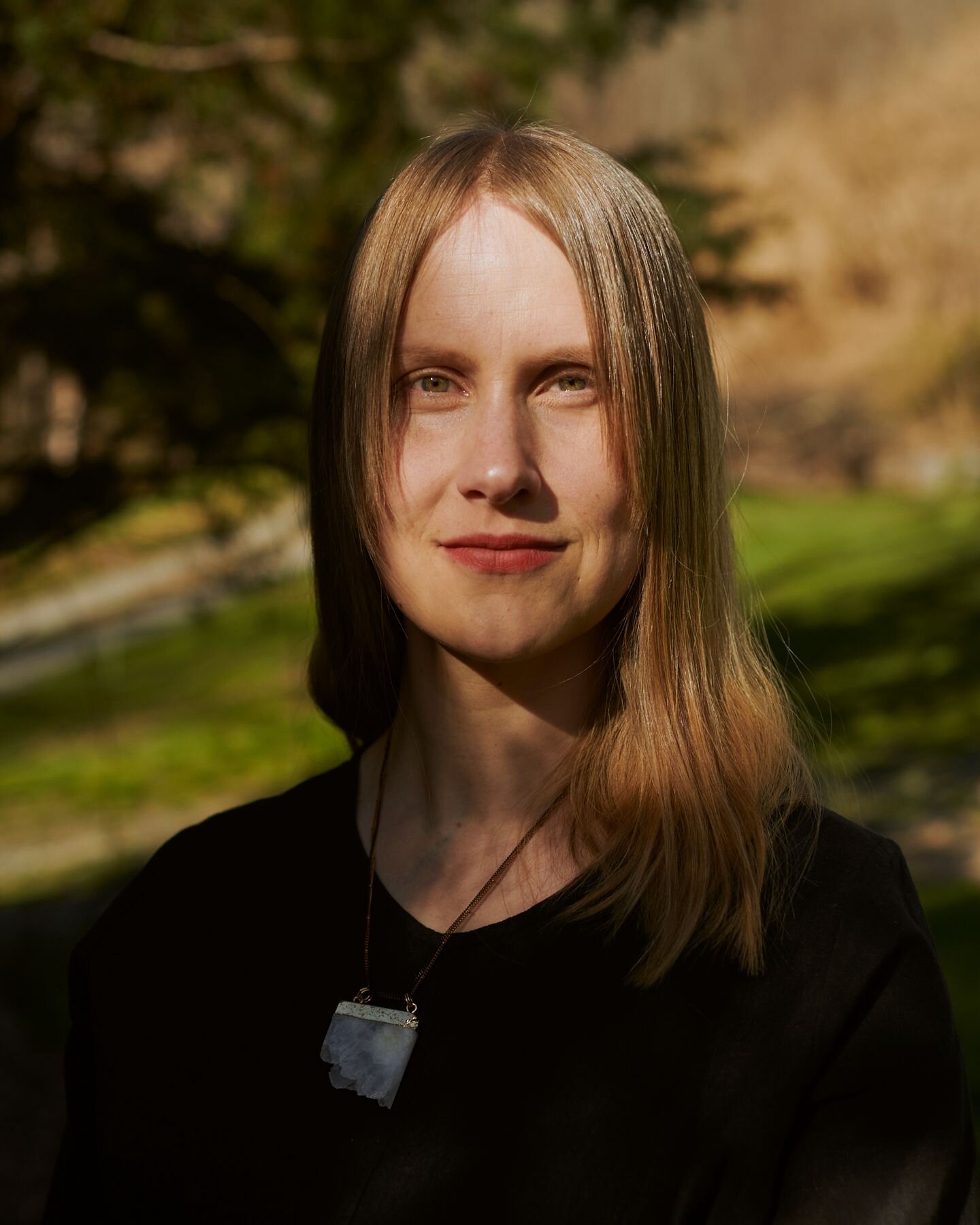
Mahshid Mayar: Hello, everyone, and welcome to Sounds of Erasure. My name is Mahshid Mayar, and I am a postdoctoral researcher working on a book project that focuses on the poetics, politics, and performative qualities of erasure poetry in the twenty-first-century United States. The project is currently generously funded by the German Research Foundation (DFG), and I work at the University of Bonn in Germany.
Today, Luca von Kirschbaum—the student assistant who has worked on this project more or less from the beginning—and I have the pleasure of hosting the writer, poet, and translator Niina Pollari.
Niina is the author of the poetry collections Path of Totality, which was published two years ago, in 2022, and Dead Horse, published in 2015. She also co-authored the split chapbook Total Mood Killer, which came out in 2017. Niina has translated, from Finnish, Tytti Heikkinen’s poetry collection, with the stunning title The Warmth of the Taxidermied Animal, published in 2012, and a couple of those translations are actually available online on Poetry Foundation—if anybody wants to check them out. Originally from Finland, she is involved in translation projects between Finnish and English and currently lives in North Carolina with her family.
Mahshid Mayar: Welcome to Sounds of Erasure, Niina. What we’re going to do today is to talk to you about your erasure work and ask you to share with us some of your thoughts about what erasure does in the poetic toolbox that you have available to you as a poet and a translator. And a few more specific questions that will come along as we carry on the conversation.
Niina Pollari: It’s a pleasure to be here. Thank you so much for reaching out and for doing this very interesting work. It’s always fascinating to hear, from a non-U.S. perspective, how this work is being engaged with. So, thanks for thinking of me.
Mahshid Mayar: Of course. Let me begin by asking you to tell us a bit more about your first encounters with erasure poetry and art. I remember around 2017—the same time I came across your poems “N400 Form”—visiting a gallery installation of erasure art by Jenny Holtzer in Boston. What I remember is that I couldn’t walk away or close my eyes. I did not know what to do with my body. And, it was the beginning of this project, this book-length project, for me. Do you remember your first encounter with erasure poetry or art? What was your emotional and intellectual response?
Niina Pollari: I have a slightly disappointing answer to this because I don’t actually remember my first engagement with erasure. But I do want to bring up a very important work for me personally and that’s Chase Berggrun’s book R E D, a book-length erasure of Dracula. It’s an incredible work. Part of what makes erasure so striking is that it’s very physical, right? And to engage with an entire book-length text, to create something new—this book kind of shocked me into the present, if that's not too dramatic to say.
Berggrun’s book grapples with the misogyny of the original work and the violence against women in Dracula by removing from it and by revealing something new. And there’s an added layer of perspective because Berggrun is a trans poet. So, consuming this work and thinking about what the action of erasure does was really foundational for me.
It’s a contemporary work. You know, Erasure has been around for a long time—cut-up poets, black-out poetry, all that kind of stuff. But I don’t know that I really paid attention to it until this. This is what I consider a very serious work. And that’s on me for not engaging with it prior to that. But, yeah, reading Chase Berggrun’s book R E D was transformative for me. And I admire Berggrun a great deal as an artist for always acknowledging the tension that is present between the source material and the resulting document. The tension and the violence in the action of erasure. To do an erasure is always to do some kind of violence upon the original text. And, Chase has talked a lot about this. This is something that I do try to keep in mind: it’s incredibly difficult in my opinion to justify that you have the right to do that to the source and you have to have a good personal reason to be able to take that on, I feel.
Mahshid Mayar: Very true, yeah. Poetry of course is halfway between inspiration and thinking through and drafting and stuff. There is an ethical concern always involved when you do erasure and I really appreciate that you brought that up, because that is absolutely central to the question of why such a project that involves so much violence, right?
Niina Pollari: Right, and if I am erasing the work of someone else—for example, I did not engage with a piece of creative writing with this piece of mine that you’re referencing—but a lot of times erasure is engaging with a piece of creative writing so you are removing the work of someone else in order to achieve what? I think that you really have to answer that question for yourself, if you are going to erase someone else’s creation. What is my justification for doing this?
Yeah, I don’t know, I kind of went deep into things right away. But I have since read or viewed more erasure and I have really come to think about the link between this kind of work and translation. For example, Tytti Heikkinen, the poet I have worked with since 2012, she doesn’t write generatively so to speak. She works from Google searches and then cuts down. So it’s a kind of translation already taking place there and a kind of erasure of sorts taking place there, when she is doing that process and then I am taking it and translating it into another language. And I just think all of these things are so intimately connected in terms of Why am I removing what I am removing? What am I trying to create? What new thing is coming into existence this way?
Mahshid Mayar: Totally, yeah. So, you also referenced your work of erasure and I was wondering, if you could tell us a bit more about the choice of the source text there. Tell us and our listeners, how did you come by the migration form and this specific version of it that you picked, and the pages that you picked. What happened?
Niina Pollari: During the first Trump presidency, I was grappling with the idea of should I file my application for naturalization? I’ve lived in the United States since I was a child, since, you know, the nineties, and I always had a green card so I was living and working, a resident, taxpayer, social security number haver. But I ask myself: What is my civic duty right now? Is naturalization the next step for me and if so, why? I’ve been here all this time, why now? And it was something to do with the fact that it felt very critical to exercise all the rights available to me, including voting. I did not file for naturalization in 2017, I waited until late last year, actually, and that also is a choice, I suppose. But I was reading the form several times, and I was wrestling with this idea of applying for citizenship. And the N400 form is a very, very long form; it’s dozens of pages long. And I was filling it out repeatedly, reading all the questions and trying to figure out what I would answer, or how I would answer these questions. I was kind of engaging with this process, doing pre-work for actually filling it out. And I practiced filling it out several times and then I printed it out and certain words really began standing out to me. The fact that the word terror appears so many times in there, and, you know, terror has multiple meanings and, of course, in the naturalization form, they are most likely referring to terrorism, so to speak. But, to me, it’s the foundational terror of asking: Do I make this choice for myself? Do I submit this form and have someone decide whether I’m acceptable or not? And I mean I’m fortunate; I don’t come from the need for political asylum or a war-torn country, or I wasn’t a refugee. My circumstances were very stable, and I was still feeling this way. And I thought a lot about how most people feel for whom this is a possible life-saving application and process. So, it had me thinking a lot about my fortunate circumstances, and my background, and the fact that I walk around and I don’t get read as Other in any capacity. All of these things started coming to me from just reading the language in the form.
Mahshid Mayar: Which is a very harsh language. It is a legal form but, at the same time, it is informed by centuries of racialization and the normalization of that language, also, which is fascinating and troubling at the same time, as you also mentioned. I guess Luca would love to follow up on that with a question on form.
Luca von Kirschbaum: Yeah, for sure. I mean this is not specific to any of your work, but I’m just curious about how you conceptualize erasure as a dialogue with the original text. Could you share how you navigate the tension between what you choose to erase and what you allow to remain, which you’ve already said a little bit about. And how do these decisions shape your artistic vision, in general?
Niina Pollari: I’m not a practicing erasure poet per se. This is really my only meaningful work of erasure. I’ve led a couple of little workshops here and there on the topic after this happened, and it took on a life of its own. But I wouldn’t say that this is my mode of creation, and I think it really had to do with this process of certain language revealing itself to me in the [N400] form. I was like, How do I convey the strikingness and troublingness of this language? and the answer was to redact everything else; redact most of the language of bureaucracy, in this case. I mentioned earlier that erasure is always an act of violence, and this form felt or feels in some ways violently reductive on the person filling it out. You have to make these yes-or-no choices and your entire life is reduced to how you answer these questions, and your future, the state of your citizenship, is determined by how you answer these questions. And, so, that was the background and justification for engaging with it the way that I did.
It really got me thinking about the language of bureaucracy and how much is hidden in there if you do start to examine it. Yeah, so I practiced filling the form out, I printed it out, and then I just took a big fat marker and I picked two pages that had stopped me in some capacity with their word choices. There’s so much more I could have done, and I thought I would keep doing it but I felt when I had done those two that it kind of said what I wanted to say. So, I stopped working with that form. I don’t know if that's a complete answer, but I wanted to let you know that it’s not my usual art. I didn’t want to write a response poem; I didn’t want to create something new from this experience. Although I have written about this naturalization process in other capacities. But, at that moment, I was like, Oh, this is the only form for this. This is the only shape of Engagement I can have with this form that kind of makes sense to how it makes me feel. I mean I suppose it was guided by feeling in some capacity.
Mahshid Mayar: It’s a job well done. As you said, it’s the only erasure poetry that you have published, but it does something that is pretty unique in its brevity and the way you use the big fat marker that you just mentioned. So… I was listening to you explaining to our listeners and to us that this project came out of several acts of reading and rereading, right? I was wondering if the broader frame of Sounds of Erasure, which is very much interested—in other words I am very interested—in the sonic aspects of erasure and the performative capacity of the erasure. If you could tell us a bit about, not the big fat marker, but if there was a microphone involved. So, how do you engage with the fact that there's so much black or blank space on the page, and then very few words to read? Have you ever thought about what it means for the N400 form to sound if somebody reads it aloud?
Niina Pollari: I’ve never read it out loud, I don’t think. I feel that a lot of erasure is very, very visual, and the blackouts and pauses are a key part of the work. Yes, you could take the words that remain on the page out and, you know, quote them in context, but the bewildering feeling of looking up and down the page and only finding like four or five moments to pause and read the sentence that is formed… the bewilderment is a part of the experience of this work. And I feel like that’s true for a lot of erasure—it’s that you are acknowledging the context, you are acknowledging what’s missing. Even if you don’t see the words anymore. And if you really look closely at the page, you can very much see the words. It’s been in a few exhibitions now, so I have it framed. If you wanted to read the source material, it’s there for you, and obviously the form is very accessible.
The feeling of Is this all? This, to me, is a big part of experiencing the work and experiencing erasure, as a whole: This is what remains and why is this what remains? Like I said, I’ve never read it out loud to an audience, but they’re so few words, it would take maybe four seconds. Something really cool happened—this work has really taken on a life of its own, it’s gone all over the world, I’ve had scholars from a few different countries reach out to me because they’re doing work around erasure in some capacity and they found it and it’s been really cool to see people engaging with it. One of the coolest things that happened was: a composer wrote to me and she said she’s working with erasures of N400 in particular; there are a couple, mine is not the only one, and she’s using that as source material to create a piece of music. This poem, along with work from the composer herself, Melissa Dunphy, and Laurel Chen, who also did a much longer work of erasure of the N400 form, all united in this performance by a choir—of the three resulting pieces. The way that they engage with the yes-no was by a lot of repeating. It’s so beautiful to hear. They ended up repeating the words yes, no, yes, no a lot of times. And, of course, the original form has a lot of yes, no, yes, no, yes, no, and I only chose to keep the one. But I feel like the way that it sonically takes up space in her composition was a good approximation to viewing a lot of redaction. Of course, it is not a direct translation; it’s an interpretation of work. But I thought I did something sonically that a blackout achieves on paper. And it was a very beautiful and interesting analog. I was really moved by the whole project.
Mahshid Mayar: I can imagine, yeah. Because the music adds another layer to the whole performativity of erasure in ways that are not always even expected and that’s just fantastic. To come toward the end of our interview, I want to repeat the question that you asked in response to the last couple of questions that I asked you: Is this all? I think that’s really important to keep asking, also if somebody is doing analytical work with erasure poetry. But, also, with poetry in general, right, because it is the abstracted, extracted sum of our emotional responses, intellectual responses to the world, right? And there is always so much more behind this and then the question is still valid, as you just posed it: Is this all? And if it isn’t, which isn’t, then what else is there that we need to pay attention to? That is one of the ways that I think erasure poetry takes on a political life of its own that a lot of other forms of poetry are not necessarily capable of, because of the way that it is visual, because of the way that it can be sonic, and because of the ways that it can result in producing music, and it can become part of protest slogans and so on and so forth. So, there’s just so much that one can do with erasure. I’ve always been really thankful for the “N400 Form” erasures that you have done. I believe, if I’m not completely forgetting something else, that was the very first erasure poetry that I actually encountered online. Since then, I have had so many sleepless nights thinking about what it means, and what do I do with it as a researcher and as an American Studies scholar.
Thank you so much, this was such a generative conversation, Niina. And I am very happy that we had you on our interview series. The second Trump presidency is very close so you would take that big fat marker out, if it still works.
Niina Pollari: Yes, oh, boy! And now I am a parent to two small children as well and it’s like What do I do with that as a new citizen? How do I do my best to do right by them politically and personally in this world? I don’t know… big questions.
Mahshid Mayar: Absolutely. Thank you so much, anyway. I look forward to reading more of your work in the future and hopefully a few of them are going to be erasure.
Thank you so much and thanks everybody for listening to this episode of Sounds of Erasure. And we’ll be back with other conversations with other erasure poets. Thank you so much, Niina.
Niina Pollari: Thank you.
